School Programmes, Syllabi & Academic Information.

GENERAL HUMANITIES

GENERAL HUMANITIES (81 hours)

Course Description 

This course is available to students coming from a variety of academic backgrounds and orientations. Its subject matter provides an overview of the broad roles of the different types of Communication and investigates the impact of Communication on individuals and consumers. It is a strongly recommended elective course for students wishing to pursue careers in Media, Communication, Humanities and Business, as well as for those who will work primarily with people.

Aim of the Course

The aim of the course is to:

  • introduce students to the field of Communication
  • enable students to understand the fundamentals of Communication
  • instil in students increased understanding of what moves human beings to create and how their creations reflect their world views
  • encourage students to think critically
  • enable students to make progress by learning how others have asked “big questions” in creative ways and, by considering the responses, answer the same questions for themselves and at the same time realise the universality of the human condition
  • provide ample opportunities for self-learning to essentially make students increasingly aware of their own communication styles
  • inspire students to develop confident public speaking skills by applying the fundamental principles of speaking in public situations to their preparing and delivering informative and persuasive presentations

Learning Outcomes

Upon completion of this course, students will be expected to:

  • comprehend and apply communication principles to personal, small group, and public situations
  • display increased self-confidence in communication settings
  • express their ideas with oral and written fluency
  • apply knowledge of nonverbal communication
  • demonstrate critical thinking competencies
  • demonstrate the ability to organise information
  • adapt messages and behaviour to different communication contexts
  • employ appropriate listening and response behaviour
  • display evident understanding of and respect for cultural and social diversity

Syllabus 

  • Introduction to the field of Communication
  • The importance of Semiotic Analysis as a means of communication in advertising
  • Overview of the fundamentals of Communication.
  • Motivation to create and how creations reflect human world views
  • Critical thinking processes
  • Self-interpretation of answers to “big questions” and realisation of the universality of the human condition.
  • Self-learning as a stimulus to an individual communication style

Contributions of Communication:

  • Introduction to the field of Communication
  • Identification of the influence of communication on contemporary and future mentality and technology.
  • Recognition and understanding of meanings and definitions of interpersonal communication and social interaction
  • In-depth appreciation of overarching structures such as culture, mass media and gender, and of their roles in shaping interpersonal interaction
  • Awareness of the dominant contemporary research in interpersonal communication and in social interaction

Resources and Booklist Suggestions

Introduction to Mass Communication: Media Literacy and Culture, Baran, Stanley J. (2012), New York, NY: Mc Graw Hill Companies.

Media and Culture: An Introduction to Mass Communication, 11ed. Campbell, R., Martin, C.R., & Fabos, B. (2011), Bedford/St. Martin’s.

Journal articles and other readings: National Assembly Bills (2013). The Media Council Act. Nairobi, KE: The Government Printer

A First Look at Communication Theory, Em Griffin (2015), 9th edition, McGraw-Hill

Advertising Campaign Strategy: A Guide to Marketing Communication Plans 5th Edition, Parente, Donald, Strausbaugh-Hutchinson Kirsten, Cengage Learning,

Strategic Thinking for Advertising Creatives (paperback), Kavounas Taylor, Alice

BUSINESS STUDIES & ECONOMICS

BUSINESS STUDIES & ECONOMICS (81 Hours )

COURSE DESCRIPTION AND AIM:

The aim of the Business part of this course is to review and increase understanding of key concepts in contemporary business, management and marketing and show how economic reasoning can be applied to decision making processes.

The course introduces the basic concepts necessary to analyse and understand the functioning of organisations. Fundamental aspects of management are discussed, such as management of change, ethics, team operation and decision making, among others. Based on this knowledge, the course will deal with challenges faced by managers of contemporary organisations, in particular issues relevant to organisational studies and the management of people within organisations, by analysing the roles of operations and information management.

The Economics part of the course is at the introductory level and surveys the economic environment within which business enterprises operate, providing insights into some of the methods and instruments that governments use to influence the economic environment. It discusses price controls, monopoly and unemployment and lays emphasis on the key conceptual tools used by economists and on the analytical techniques of Economics in order to enhance understanding of the production, consumption and monetary aspects of the market.

Specifically, this part is divided into the two main units of Microeconomics and Macroeconomics. The former introduces the students to key microeconomic issues, such as scarcity and choice, demand and supply, free markets and price controls, as well as to the laws governing different market structures. The latter focuses on teaching macroeconomic concepts such as measurement of economic activity and national income, the role of the government in the economy as a whole and the nature of money and its supply and the influence of all of these on interest rates and inflation.

Using the case study methodology, the course intends to enable students to solve real world business problems by integrating the use of key concepts and tools of analysis. In addition, it aims to cultivate appreciation for how corporations and economic processes work together in a business environment. The development of critical skills is of paramount importance in the course, in an effort to ensure that students succeed in their academic studies in the UK. These skills include building team expertise, making effective oral presentations, developing critical thought processes, thinking strategically and adhering to ethical codes in solving business problems.

LEARNING OUTCOMES:

Upon completion of this course, students will:­

  • understand issues bearing on the financial management of firms
  • appreciate market dynamics, consumer behaviour and marketing processes in the context of their significance in the management of changing environments
  • comprehend issues related to organisational studies and the management of people within organisations
  • analyse the role of operations and information management within an organisation
  • analyse an organisation’s environment and demonstrate awareness of strategy
  • be aware of contemporary issues in management such as those bearing on the management of change and business ethics, among others
  • show critical awareness of management knowledge, such as that relevant to consumption or organisational studies
  • understand how resources are used and how households and firms behave and interact, both at the individual and collective levels
  • study the factors influencing income, wealth and well-being
  • inform business and organisational decision making and the design and implementation of economic policy by government agencies
  • understand and critically evaluate the allocation and utilisation of scarce resources and the consequences of related decisions on business and social outcomes
  • apply modern methods of business and economic analysis, including a high degree of numeracy and confidence in data handling
  • use appropriate tools of analysis to tackle issues and problems of economic decision making and policy through a range of generic skills, analytical skills and the ability to select and use appropriate models to solve real world problems

SYLLABUS:

  1. Microeconomics
  • Introduction to Microeconomics, Scarcity & Choice. Opportunity Cost.
  • Production Possibility Curve Positive – Normative Economics.
  • Tools of Economic Analysis. Models & Data, Index Numbers. Nominal & Real Numbers Diagrams, lines, equations.
  • Demand (Law – Determinants – Shifts in the Demand Curve) Supply (Law – Determinants – Shifts).
  • Demand & Supply – Equilibrium price & Output. Price Controls (price ceilings – floors).
  • Elasticities of Demand and Supply. Point, Arc, Cross Elasticities.
  • Theory of Production. The short – run Production Function. Average – Marginal product. Law of Diminishing Marginal Returns.
  • Cost Theory. Fixed – Variable Marginal cost (short-run)
  • Economies, Diseconomies of Scale. Returns to scale (long-run).
  • Revenue (Total, Average, Marginal, Profit Maximization)
  • Market structure. Perfect competition – Monopoly (short-run, long-run, supply decisions).
  • Monopoly – Oligopoly – Cartels – Monopolistic Competition (short-run, long-run, supply decisions). Analysis of Factor Markets.
  1. Macroeconomics
  • Introduction to Macroeconomics Circular Flow Model. Measuring the Macro-economy (basic indicators). Ways of Calculating GNP.
  • Determination of National Income. Simple Keynesian Analysis. National Income (consumption function). Multipliers.
  • Aggregate Demand + Aggregate Supply Schedules.
  • Money Supply. Money and its Functions. Money Multipliers
  • Unemployment – Inflation. Types – Definitions – Costs – Phillips Curve
  • Open Economy Macro. The Foreign Exchange Market. Floating and Fixed Exchange Rates.
  • The Balance of Payments (components – items).

III. Topics in Business Studies 

  • Basic principles of Management and Marketing.
  • The Human Factor in the Business environment.
  • External & Internal Business Environment, Competition, SWOT Analysis.
  • Marketing – The 4 Ps
  • Industry and Services – Presentation and differences.
  • Principles of Accounting.
  • The Balance Sheet
  • Management: Functions, Motivation, Decision Making
  • Leadership in Management: Qualities, Styles
  • Business Ethics

Resources and Booklist suggestions:

  1. Betty J. Brown & John E. Clow, Introduction to Business, McGrow Hill Glencoe 
  2. Andrew Gillespie, 2010, Business Economics, Oxford University Press
  3. Business Basics: A study guide for degree students, Economics, BPP Publishing
  4. Begg David, Fisher Stanley, Dornbusch Rudiger, ECONOMICS, 5thedition, McGraw Hill
  5. Baumol William, J. Blinder Allan S., ECONOMICS: Principles and Policy, 4E, 1988, Marcourt Brace Jovanovich.
  6. Gwartney Jouyes, Clark J.R., Stroup Richard, ESSENTIALS OF ECONOMICS, 2E, Marcourt Brace Jovanovich.
  7. Samuelson Paul. A.Nordhaus William D., ECONOMICS, 13E, McGraw Hill Int.
  8. M. Pride, R.J Hughes and J.R. Kapor, BUSINESS, International Student Edition, Houghton Miffling Company, 4thedition 1993.
  9. Essentials of Accounting, Robert N. Anthony, Addison-Wesley

 ART & DESIGN

Course description

The Art & Design Foundation course will enable students to develop an understanding of the principles and practices in art and design, as well as gain knowledge and build a portfolio of experimental work that will result in the submission of successful applications to undergraduate programmes.

The syllabus considers expression and communication of ideas as much as the development of skills that would encourage understanding of visual perception and aesthetics. Most of the work produced would be practical or studio based, so that students can develop their abilities of observation and analysis of the visual world, which in turn would aid expression, imagination and creativity. The course also provides contextual studies and the content has been structured to broaden the students’ knowledge and enhance their ability to combine theory and practice and to develop their problem solving processes. Furthermore, the students have the choice to work on a topic that is relevant to their chosen pathways and learn how to develop a self-initiated project.

The course will offer students the chance to explore subjects in creative arts and design that are not available in other courses at our school. Students on the course, in addition to their Art & Design Studies will be able to study Fine Art, 3D Animation, Illustration, Graphic Design, Video Games, Photography, Fashion Design and Architecture, among others.

In short, the year-long Foundation course in Art & Design is a creative and inspiring multidisciplinary course that encourages students to explore different aspects of art and design, identify their strengths and develop pertinent skills and techniques.

Structure

The course is divided in two sections. The first explores core subject areas in visual arts and design, while the second focuses on the production of a final portfolio of creative work. Successful preparation of the portfolio is a key advantage for students wishing to be admitted to an undergraduate programme at a UK University.

An additional bonus for students would be the exploration of the city of Thessaloniki as a pool for inspiration and as a centre of civilisation and culture, by means of visits to museums and galleries and participation in art events. Seminars and lectures by visiting lecturers and seasoned professionals with diverse backgrounds are run throughout the academic year.

Aim of the course

The aim of the course is to:

  • Encourage experimental work that reflects a personal style and identity
  • Establish the acquisition of technical skills as well as visual and inspirational skills
  • Enhance Creative Thinking
  • Impart understanding of the historical, social, cultural and economic contexts of Art and Design
  • Foster research, methodology, and idea generating processes
  • Develop teamwork, self-management, time-management and professionalism
  • Produce committed, creative and confident students

Learning outcomes

By the end of this course students should be able to:

  • Deal with traditional, technical and experimental approaches to drawing and illustration
  • Have a diverse background of knowledge in art, design and cultural subjects
  • Work in teams and produce art work
  • Develop an understanding in art and design projects
  • Reflect upon methods, materials and outcomes
  • Visualise, execute and communicate effectively their ideas
  • Understand processes required to investigate, develop and deliver a creative approach
  • Make their own processes and decisions in art and design problem solving issues
  • Develop their skills in time management and organisation of their work
  • Develop their own independent thinking and aesthetic style
  • Demonstrate creativity and produce original work
  • Present a high standard portfolio that will reflect their future professional direction

Syllabus

The course places special emphasis on acquisition of skills in drawing, painting, design, mixed-media techniques, self-directed study, resource-based learning (libraries, videos, films, magazines, journals, internet) research, observation and creativity. It is practice-based and work-based.

Throughout the course the students’ progress will be monitored by means of tutorials, reviews, group discussion and presentations, course work and assessments. These procedures are designed to support the students’ independent study and experimentation work through critical feedback from the tutor.


  • Basic  Sketch Drills (the importance of drawing, improving the basic idea, from creative thought to image creation)
  • Colour Theory (basic colours, colour combination, colour wheel,)
  • Basic Composition Theory (Simplify the scene, Avoid the middle, Space to move, Creative with colours, Breaking the rules)
  • Drawing Media and Techniques (Pencil, charcoal, ink, collage, aquarelle, acrylics, mixed media, brushes)
  • Elements of Design (Color, Line, Shape, Direction, Space, Texture, Value)
  • Principles of Design (Balance, Contrast, Emphasis, Harmony, Movement, Rhythm)
  • Sketchbook Preparation (the importance of sketchbook as a part in artwork portfolio)
  • Mixed Media Expressions (Texture, materials, collage, combinations)
  • Inspiration Sources (How to find inspiration sources)
  • Inspiration – Sketches – Final Project (How to present the final project by showing creative thinking)
  • Photography Basics (Image, composition, scenario)
  • Photography Technical Guides (How to use photography equipment)
  • Photoshop (From basics to advanced)
  • History of Art (Renaissance, impressionism, modern art, expressionism)
  • History of Art Projects (Presentations in various history of art themes)
  • Portfolio Preparation (Artwork portfolio contents according to chosen courses)

Greek vs British Educational System

Diagram of the Greek Equivalence to the British Education System (10th-12th grades)

Although there is no exact analogy between the British GCSE and GCE awards and the Greek Lyceum Apolytirion, the following diagram depicts the corresponding stages in the two educational systems and is helpful in understanding why Greek Lyceum students who simultaneously attend a Foundation course are probably the best prepared students for British Universities.

The Lyceum Foundation preparation option, shown in the Diagram below, is analysed in detail in a separate document.

Please follow this link:  https://www.youtube.com/watch?v=ZD1u4GT-qh8

The Vice Rector of the University of Athens (Professor Fortsakis) Comments on the Pan-Hellenic Examination and its Academic Significance (November 2014)

The Pan-Hellenic examinations have been an issue that has troubled the Greek educational system for many decades now.

Several Ministers of Education, from different government schemes, have attempted to reform the exams, but due to a number of issues the exams have been frozen to a dry selection process with which Greek candidates are selected for enrollment to Greek HE institutions (AEI and TEI).

The worst problem of the Pan-Hellenic exams is that these exams are rewarding the candidates who have been doubling-up their text books and writing onto their exam paper in the best possible way as their own answer; not because the candidates prefer this way, but because this is what the exams system grades as the best answer.  Thus, the whole secondary education which is practically preparing the students for the University entrance exams is promoting/exercising rote learning, instead of critical thinking.

It is no wonder why Greek students in UK Universities many times can handily commit plagiarism; it is because this is what they are used to and they cannot conceive that it an offence.

The oxymoron Institutionalised Plagiarism has become the best (sarcastic, yet true) description for what is happening in Greek education.  You may find more information on this issue in a study compiled by our organisation titled:  The 2 Available Options in the Greek Apolytirion and the “Institutionalised Plagiarism” Problem.

In the link below, please find a recent video (November 2014) from a very popular commentary broadcast of the Greek TV, where Professor Fortsakis, Vice Rector of the University of Athens, states his opinion regarding the Greek higher education matriculation process and its academic significance as a University entry qualification.

Please follow this link:  https://www.youtube.com/watch?v=ZD1u4GT-qh8

Greek vs British Educational System

Important Info for Admissions Tutors and International Officers

INFORMATION FOR UNIVERSITY ADMISSIONS, TUTORS & INTERNATIONAL OFFICE

Foundation Preparation:  a) in Parallel to Greek Lyceum and, b) after Graduation from Lyceum

The NETWORKFoundation Programmeduring the past twenty-three years has continuously been offering training, academic planning and consulting services to Greek candidates who wish to pursue undergraduate studies in the UK, and with two main sites in Athens and Thessaloniki it is currently the principal Foundation provider in Greece.

In fact, according to official UCAS statistics, NETWORK is the largest UCAS School in Greece (as regards the number of student acceptances for 2012,2013,2014 and 2015 Entry).

NETWORKoffers two Full-time curriculum Foundation Programmes:

  1. The NETWORK Lyceum Foundation Programme, offered to students attending the second and third classes of Lyceum (Greek High School 11th and 12thgrade) which runs in parallel with high school.  This full curriculum programme is split over two academic years part-time in order to cover the complete syllabus.  Students attend 3 days / 11 hours per week.
  2. The NETWORK Winter Foundation Programmewhich is offered to Greek Lyceum graduates (Greek High School 12thgrade graduates).  This programme’s duration is one full academic year.  Students attend 5 days / 22 hours per week.

Given that most tutors may be already familiar with our Winter Foundation Programme, we would like to present you with certain details of our Lyceum Foundation Programme, which is becoming more and more popular to Greek students who have selected the UK as their primary undergraduate study destination.  (Tutors Manual & Academic Information:  www.network.gr/academic)

NETWORK Lyceum Foundation

This option has become very popular in the last 4 years and from our experience to date, students who choose this route constitute a particularly strong population sample among applicants from Greece with respect to character, motivation, academic credentials and determination to succeed in the British Education System.

The NETWORK Lyceum Foundation Programme (4-modules plus English) for all students who attend it is the primary preparation for UK University admission.  The Apolytirion in this case should be considered as a school leaving certificate and not as a University entry qualification.

Lyceum Student Apolytirion Qualification:  While the “nationally examined” (with Pan-Hellenic exams) Greek Apolytirion represents a demanding qualification, students who are taking the Lyceum Foundation (i.e. “parallel” course, while also at the Lykeion/Lyceum), take the school leaving Apolytirion – referred to as “internally examined” Apolytirion.  According to Greek state law No. 3966/2011, both Apolytirion (the internally examined and the panhellenically examined) are coequal as high school leaving certificates and both offer the right to continue to higher education.

Student Academic Focus:   The “internally examined” Apolytirion allows students to focus their effort on the Foundation course thus ensuring optimum preparation for their studies in the UK.  Selectors are therefore advised to make admission offers on the basis of performance on the Foundation course rather than the Apolytirion.

Student Profile:   Students taking the “parallel” Lyceum Foundation course alongside their Apolytirion are committed to studying in the UK, while those taking the nationally examined Apolytirion are primarily committed to studying in Greece and would normally only join a UK institution if they failed to reach the standard required for admission to their desired Greek institution.

There are at least 7 reasons that justify the qualitative advantage of the Lyceum Foundation students over other candidates:

  1. Determination– Lyceum students, who at such a young age take the decision to study in the UK, are those who are most predisposed to travel to foreign countries and achieve superior academic and professional performance.  They can recognize the deficiencies of the Greek Higher Education and display maturity that is rare among young people of the same age group.
  2. International Culture– These students and their families are characterised by a more international / cosmopolitan outlook, which leads them to abandoning the rather monolithic procedure of rote learning during their preparation for and subsequent sitting the Pan-Hellenics, deciding instead to focus on gaining an Apolytirion (school leaving diploma) that is more holistic in its approach to an all-round provision of education.
  3. Enthusiasm to study in the UK– Lyceum students who take the decision to study in the UK are significantly friendlier towards and more familiar with British culture.  They truly desire to attain high standards within a system they deeply feel as being one of the top in the world. Eventually, when they are offered a place to a British university programme, they are enthusiastic about this opportunity and dream of the day that they will be given the opportunity to achieve high grades at university.
  4. Customised Preparation– It is also important to point out that we consider it an advantage that the Lyceum Foundation students begin their preparation for British universities early, along with their second class of Lyceum (11thgrade); this eventually offers them the opportunity to learn and absorb more efficiently many aspects of the British educational system and its principles.  They learn how to conduct research, how to deliver presentations and how to work on assignments, concurrently with their studying for Greek High School.
  5. Educated Orientation– Since the Lyceum Foundation modules during the first phase of the parallel foundation programme are of more general content (Mathematics, Statistics, Computing, Study Skills and English), these candidates have the opportunity to obtain more detailed and comprehensive consultation regarding selection/direction of studies.  By the beginning of the second phase of the Lyceum Foundation, students have researched and evaluated all options, have become familiar with most courses and disciplines offered in the UK and can very securely and maturely make their decisions.  As a result they can select the appropriate modules of the Foundation course and proceed with their UCAS application.
  6. Focus on UK studies– Students who attend the Lyceum Foundation (parallel Foundation Programme) are strongly focused on achieving a high academic performance in both their Foundation Programme and the final two years of their Greek Apolytirion studies, without having to devote their time to an exams oriented approach aimed at achieving specific scores in the Pan-Hellenic examinations. These students are not only academically, but also psychologically ready to attend a British university at the age of 18, their readiness and preparation are the best guarantee for a superior academic performance during their attendance at a British institution.
  7. Familiarity with the English Language– Being trained and exposed to the English language for two years (a longer period than all other Foundation courses) and attending all modules in English, the Lyceum Foundation students are very well experienced to cope with their studies by being familiar with the language and the system.  After having finished their Foundation programme, students just travel to their UK destination and continue studying in the exact same manner and means without needing any adaptation period.

Diagram of the Greek Equivalence to the British Education System (10th-12th grades)

Although there is no exact analogy between the British GCSE and GCE awards and the Greek Lyceum Apolytirion, the following diagram depicts the corresponding stages in the two educational systems and is helpful in understanding why Greek Lyceum students who simultaneously attend a Foundation course are probably the best prepared students for British Universities.

IMPORTANT Q&As WITH STUDENTS, PARENTS AND THE BRITISH COUNCIL

The majority of the candidates who wish to apply to UK Universities for their undergraduate studies usually start by getting initial advice from the British Council in Greece.  When it comes to considering preparation via a Foundation programme in Greece, the Council has a standard line of advice using the following exact quote: “The British Council is not responsible for the quality of Foundation programmes in Greece, therefore we advise you to contact the institutions directly and ask if the school you are planning to register for your Foundation course is recognized by the universities you wish to apply to.”


The first part of the quote regarding the quality of Foundation programmes in Greece would not sound very complimentary, as stated, to students and parents. However, it is not important to focus on that but on the second part of the quote referring to recognition.


For example, a prospective student would ask the following:

“Is *name* Foundation recognized by your University?”

which, of course, if answered typically the answer would be

“No, it is not.”

(and this is typically correct, because no school in Greece or elsewhere can be officially recognized by all UK institutions at the same time; such thing can’t physically happen anyway).

As a result, the student will assume that he/she will not get any offers from the Universities which replied that they do not officially recognize the specific Foundation school.

But this is not the case. For example, NETWORK Foundation students are indeed offered places based on their Foundation qualification by almost all UK Universities.

Actually, what the candidates should be asking is the following:

“I am planning to attend the *name* Foundation Programme.  If I apply to your University and I include the above Foundation qualification, would you consider my application for admission?”

For the above reason we would kindly ask you, when you are asked if a school in Greece is recognised, to explain to them what the actual case is.  For example, this could be a standard reply:

“Our University does not have any official recognition agreement with *name* Foundation Programme, but if you apply to our University we will be able to examine your application based on your Foundation and other qualifications and accordingly consider offering you a place.”

More specifically, if a candidate asks about our school, NETWORK, and given that your institution has previous knowledge/experience with the NETWORK Foundation Programme, you might consider adding the sentence below in your standard reply:

“Our University has considered candidates and has offered places to students based on their NETWORK Foundation qualification.”

In this way, the candidates will not believe that attending the specific Foundation course translates to a closed door for them, and additionally if they have anyway decided to attend the specific Foundation course, they will not exclude your University from their choices.

For your records, the British Council has an online list of recognized schools in Greece that offer Foundation courses and the NETWORK Foundation Programme, both in Athens and Thessaloniki, is included in the official list

https://www.britishcouncil.gr/sites/default/files/foundation-courses-and-gces-19-05-2016.pdf

Apolytirion and PanHellenic Exams

The Greek Apolytirion, The Pan-Hellenic Exams and the “Institutionalised Plagiarism” Problem

Study:  NETWORK Foundation Programme – © 2016- info@network.gr

Sources:  Greek Ministry of Education, DOATAP (Greek NARIC), NETWORK Educational Group (knowledge base archives).

The Apolytirion, is internally examined in the individual high schools.  It is officially recognised not because the examinations are monitored, accredited or approved, but because all these Apolytirion high school leaving examinations take place in high schools that are recognised by the Greek state as local examining bodies (Lykeion/Lyceum).

A certificate entitled “Apolytirion” may only be issued by a state recognised Lykeion.  However, no official validity or comparison of quality between Apolyteria from different high school can take place, since these school leaving exams are local, independent and without specific guidelines for quality, difficulty or context.

It has been official since 2011 that the internally examined Apolytirion (without Pan-Hellenics) is fully accredited as a school leaving certificate (Greek State Law No.3966/11).   As stated in Greek law the Apolytirion is not an entry qualification for the Greek Universities.  However, it grants the right to pursue entry to higher education at a later date.  As a result, the Pan-Hellenic examination, which is now an independent process and by no means related to the Apolytirion certificate is the only entry qualification for the Greek Universities.

The Pan-Hellenic examinationssare University entrance exams that are nationally examined and are designed, set and run by the state.  The exams are same and common for all participants.  The Pan-Hellenic exams, since 2015 are totally independent with the Apolytirion and their grades do not appear any more in the Apolytirion of the students.  This examination process, from now on, is only for matriculation purposes.

Students who wish to be admitted to a Greek university are required to sit the Pan-Hellenic examinations, for which, as a rule, the vast majority of students attend evening private preparatory schools (frontistirion) for 5-6 evening sessions per week in order to be well prepared.

However, students are not aware of which university, or even which specialisation they will be eligible to attend, before the end of July.  This has to do with the rationale underlying the university entry requirements with Pan-Hellenic exams, according to which the exact university, university department, and the specialization of study are interdependent on the marks achieved by all other candidates.

The Greek matriculation system is characterised by uncertainty and above all is a system still based on a student’s capacity for rote learning of a substantial amount of information in order for the student to achieve the necessary marks.

The question that arises concerning the necessity for students to learn by heart the relevant material is answered by the grading system of the Pan-Hellenic exams.  What essentially happens is that thousands of teachers are obliged to act as exam paper graders and mark tens of thousands of exam papers on the basis of the proximity of the papers to relevant textbook information.

As the marking system is not founded on automation through an objective multiple choice answer sheet, or on analytical strict guidelines on what constitutes evidence of critical and analytical abilities needed for university, subjectivity starts playing an important role.

In order to minimise the graders’ subjectivity factor, the benchmark on which teachers marking Pan-Hellenic exam papers rely on is the similarity to and/or proximity of an answer to textbook material taught during the last year of Lyceum.

The results in thousands of Greek students for the past 30 years having to virtually resort to “plagiarism” in order to be admitted to Higher Education.

This system does not test intelligence, as such, or critical thinking, but rather an ability to memorise.  As a result, many intelligent and capable students who do not perform well on rote learning do not get into the universities of their choice.

Conclusion

Students who decide they do not want to attend Greek universities opt for the internally examined Apolytirion option.  From 2015 and onwards, the Apolytirion route, combined with parallel preparation offered within the framework of a Lyceum Foundation course, may be considered as a solid basis for successful completion of a Bachelor’s degree, whereas the students who apply to UK Universities using Pan-Hellenic exams as their entry qualification are prepared in a rote learning system with a poles apart state of mind and without any experience in academic subjects delivered in the English language.

Catering & Accommodation

Coffee and tea is always freely available in all our premises to visitors. The main Athens campus as well as the Thessaloniki one, are located in fully developed areas, with a number of restaurants and coffee shops that provide light lunches and snacks at modest prices. Students from Athens orThessaloniki usually live at home, but for students from other parts of Greece who come to Athens or Thessaloniki, we provide references to local rented housing.

Facilities

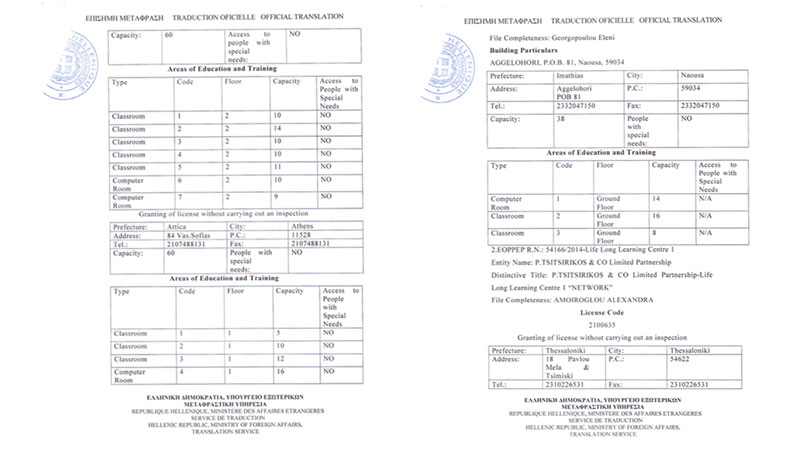
NETWORK Educational Services has all the teaching and laboratory facilities that are necessary for its courses. It is our policy to maintain the maximum degree of inter-activity between tutors and students, and we are unique in having small class groups of 14 students or less. All presentation material is available, such as large white marker boards, flip-charts, overheads, slide, liquid transparent screen and HDMI video projectors and TV equipment.

The computer laboratories are equipped with Intel Core i3 or i5 PCs with at least 2 GHz CPU speed and 4GB RAM capacity,  connected to Local Area Networks and to the Internet, running Windows 7/8/10.  Our Software Repository includes all the necessary office automation applications. The administrative and the tutors’ computers are also connected to the same network, allowing a centralised management, grading and filing of all students’ reports and projects. Access to fully equipped Physics , Biology and Chemistry laboratories is also available.

CLASSROOMS:

ATHENS THESSALONIKI
  • 7 Amphitheaters
  • 4 Computer Labs
  • 1 Studio
  • 1 Library
  • 2 Coffee and Break Lounges – Rooms
  • 5 Amphitheaters
  • 2 Computer Labs
  • 1 Studio
  • 1 Library
  • 1 Coffee and Break Lounge